

Economy
EU Removes Nigeria from High‑Risk Financial List

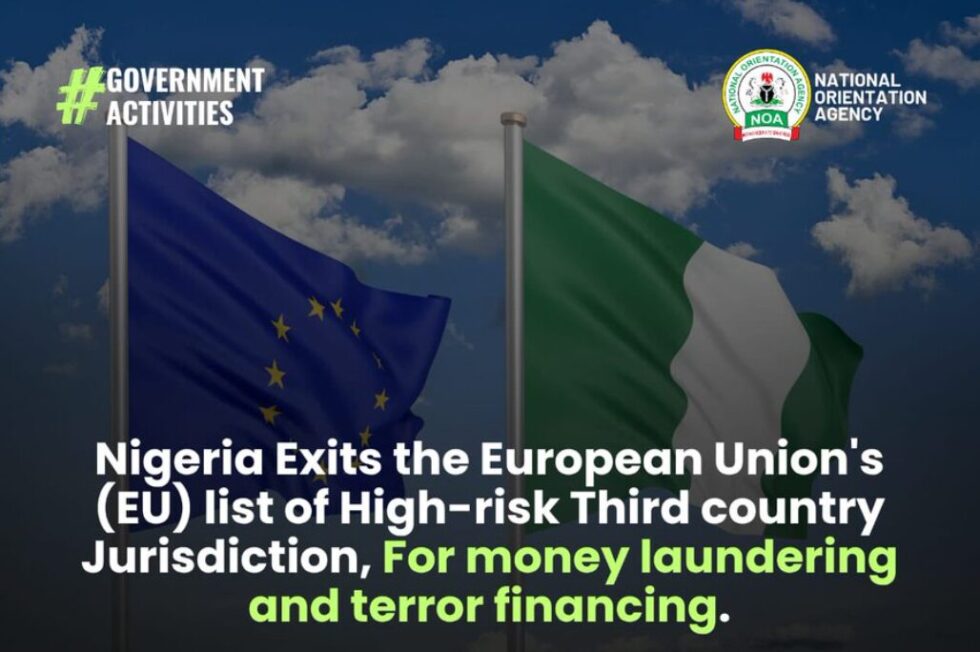
The European Union (EU) has officially removed Nigeria from its list of high-risk third country jurisdictions for money laundering and terrorism financing, a major milestone following the country’s exit from the Financial Action Task Force (FATF) grey list in October 2025.
The decision was published in a European Commission Delegated Regulation (EU) C (2025) 8460, adopted on December 4, 2025, and will take effect from January 29, 2026 after procedural approval by the European Parliament and the Council.
Nigeria was delisted alongside five other African countries, South Africa, Burkina Faso, Mali, Mozambique and Tanzania, after demonstrating significant reforms to strengthen their anti-money laundering (AML) and counter-terrorism financing (CFT) frameworks.
Reacting to the development, Nigeria’s Minister of State for Finance, Dr. Doris Uzoka-Anite, described the removal as a “big win for Nigeria! Removed from the EU’s financial ‘high-risk’ list! Congrats to President @officialABAT on this achievement. As Minister of State for Finance, I’m proud of this boost to trade and investor confidence,” in a post on X.
The Nigerian government has welcomed the delisting as a testament to the country’s sustained efforts to improve financial transparency and compliance with international standards.
The Federal Ministry of Finance said the decision reflects the extraordinary leadership and reform vision of President Bola Ahmed Tinubu, whose administration prioritised AML/CFT reforms.
The EU removal is expected to have tangible economic benefits, including the lifting of enhanced due diligence requirements applied to transactions with high-risk jurisdictions.
This will likely ease compliance burdens, support smoother cross-border financial flows, improve correspondent banking relationships, and boost trade, investment and financial partnerships between Nigeria and EU member states.
Being classified as high-risk previously meant Nigerian transactions were subject to stricter documentation, higher scrutiny and increased costs. The decision strengthens Nigeria’s global financial credibility and sends a positive signal to investors about its commitment to robust financial governance.